
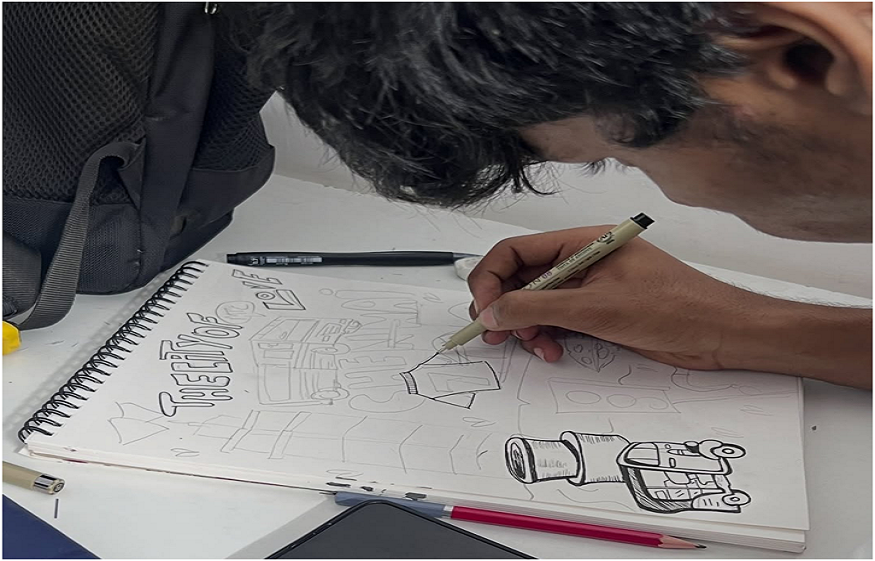
Preparing for entrance exams like NID and NIFT is very different from preparing for regular academic exams. This is something most students realize only after they seriously begin preparation. Unlike board exams where answers are usually fixed and predictable, design entrance exams evaluate how students think, observe, imagine, and solve problems creatively.
That difference is exactly why many students feel confused during the initial phase of preparation.
Some students begin by practicing random sketches every day. Others focus only on aptitude questions. Some spend hours watching portfolio videos online without actually practicing consistently. And many students quietly struggle with self-doubt because they think they are “not creative enough.”
The truth is, cracking NID, UCEED, CEED or NIFT is not about being born with extraordinary talent. It is usually about understanding the exam properly, practicing consistently, and avoiding the common mistakes that most aspirants unknowingly make.
Over the years, certain patterns keep repeating among students preparing for design entrance exams. Many students work extremely hard but still struggle because their preparation lacks direction. Understanding these mistakes early can save students a lot of confusion, stress, and wasted effort
1. Believing That Design Exams Are Only About Drawing
This is probably the most common misconception students have.
Many aspirants assume that if they improve realistic sketching or shading, they will automatically perform well in NID or NIFT. Because of this, they spend months practicing portraits, still life drawings, or copying artworks from Pinterest and Instagram.
Read More: Connecting Word Meanings Through Semantic Mapping
But design entrance exams are not fine arts exams.
These exams are not searching for students who can simply draw beautifully. They are looking for students who can:
- Think creatively
- Observe carefully
- Solve problems visually
- Communicate ideas clearly
A rough sketch with an original idea can often score higher than a perfectly rendered drawing with no creativity behind it.
Students who focus only on technical drawing skills often struggle during questions that require ideation, storytelling, innovation, or problem-solving.
Drawing is important, but drawing alone is not enough.
2. Ignoring Observation Skills
One major difference between beginner students and strong design aspirants is observation.
Good designers notice details that most people ignore.
They observe:
- Human expressions
- Street activities
- Everyday objects
- Body language
- Light and shadows
- Spaces and environments
- Small visual patterns
But many students preparing for design exams avoid observation drawing completely. Instead of sketching from real life, they only copy reference images from the internet.
This creates a major limitation.
When students depend entirely on references, they often struggle in exams where they must draw scenes from imagination or memory. Their visuals begin to feel stiff and repetitive because they have not trained themselves to observe naturally.
Observation drawing improves much more than sketching ability. It improves:
- Visual memory
- Composition
- Creativity
- Storytelling
- Understanding of proportions
- Confidence in visualization
3. Preparing Without Understanding the Exam Pattern
Another common mistake is preparing blindly without fully understanding how the exams work.
Many students start practicing random topics without studying:
- Previous papers
- Question patterns
- Evaluation criteria
- Time limits
This usually leads to unstructured preparation.
For example, NID and NIFT may both be design entrance exams, but they test students differently.
NID focuses heavily on:
- Conceptual thinking
- Creativity
- Visual storytelling
- Problem-solving
- Observation
NIFT also includes:
- Creative ability
- Fashion awareness
- Logical reasoning
- General aptitude
Students who do not understand these differences often prepare inefficiently.
Preparation becomes much more effective when students understand what the exam is actually testing.
| Nift coaching centres in chennai | Nid coaching classes in ernakulam, kerala |
| Uceed coaching in chennai | CEED Coaching classes in hyderabad |
4. Depending Completely on Talent
Some students assume:
“I’ve always been creative, so I’ll manage somehow.”
Others believe:
“Creative people don’t need much practice.”
This mindset becomes dangerous during preparation.
Natural creativity definitely helps, but entrance exams also require:
- Speed
- Time management
- Structured thinking
- Consistency
- Presentation skills
Even highly talented students struggle if they do not practice regularly.
Meanwhile, many average students improve dramatically simply because they stay disciplined and consistent over time.
Creativity grows with practice.
The students who improve the fastest are usually not the ones with the most talent initially — they are the ones who stay consistent even during frustrating phases.
5. Poor Time Management During Practice
Many students practice without timing themselves.
This becomes a major problem during the actual exam because design entrance exams are heavily time-based. Students may have good ideas but fail to complete answers properly within the given duration.
This creates panic during exams.
Students preparing seriously should regularly practice:
- Quick ideation
- Fast visualization
- Timed sketching
- Rapid composition exercises
Learning how to simplify ideas visually within limited time becomes extremely important.
Good time management often creates a huge advantage during entrance exams.
6. Comparing Yourself Constantly With Others
Social media has made design preparation emotionally harder for many students.
Every day, aspirants see:
- Perfect sketchbooks
- Highly polished artworks
- Advanced portfolios
- Professional-looking illustrations
As a result, many students start feeling:
“I’m not good enough.”
“My work looks bad.”
“Everyone is more creative than me.”
But constant comparison quietly destroys confidence. Students forget that social media usually shows only polished final work — not the years of practice, mistakes, failed sketches, and learning behind it.
Design preparation is personal. Every student develops creativity differently and at a different speed. The goal is not to become identical to other students. In fact, originality is one of the most important qualities design colleges look for.
Related: Common Mistakes to avoid in UCEED, CEED and NID 2027 Design preparation
7. Ignoring General Awareness and Design Awareness
Many students focus only on sketching practice and completely ignore general awareness.
But design is deeply connected to:
- Culture
- Society
- Technology
- Fashion
- Architecture
- Human behavior
- Visual communication
Students preparing for NID and NIFT should actively observe the world around them.
Simple habits can help a lot:
- Reading articles
- Observing advertisements
- Following design trends
- Visiting exhibitions
- Watching films critically
- Studying branding and packaging
Creative thinking improves when students expose themselves to different forms of visual culture. Good designers are usually curious people.
8. Waiting for Motivation Instead of Building Consistency
This is another huge mistake.
Many students prepare intensely for a few days, then stop completely for a week. They wait for motivation before practicing again.
But creativity does not improve through occasional motivation.
It improves through routine.
Even one focused hour daily creates much more improvement than random bursts of preparation.
Small consistent practice sessions help students develop:
- Observation habits
- Faster ideation
- Better visualization
- Creative confidence
Consistency matters far more than intensity.
9. Ignoring Previous Year Papers
A surprising number of students prepare for months without properly analyzing previous question papers.
Previous papers help students understand:
- The level of creativity expected
- Common question types
- Time pressure
- Visual communication style
- Difficulty level
They also help students identify weak areas early. Without analyzing previous papers, preparation often becomes directionless and repetitive.Students begin practicing random exercises instead of developing exam-specific thinking skills.
10. Losing Confidence Too Early
Perhaps the biggest challenge during design preparation is self-doubt.
Because creativity is personal, students often become emotionally affected when:
- Ideas don’t work
- Sketches look weak
- Others seem better
- Improvement feels slow
Many students quietly convince themselves:
“Maybe I’m not creative enough for design.” But the reality is that creativity develops gradually.
No designer improves overnight. The students who eventually succeed are often the ones who continue practicing despite frustration and uncertainty. Creative growth is rarely linear. Some weeks feel productive, while others feel slow and confusing. That is completely normal. The important thing is to keep going.
Why Proper Guidance Makes a Huge Difference
One reason many students struggle unnecessarily is because they prepare alone without proper direction. Sometimes students practice hard but focus on the wrong things. Others do not receive feedback on their work and continue repeating the same mistakes.
Good mentorship can help students:
- Understand exam expectations
- Improve creatively
- Build confidence
- Develop observation skills
- Learn structured preparation methods
At MAD School, students are encouraged to approach design preparation in a much more practical and creative way. Instead of focusing only on memorized techniques, students are guided to improve observation, ideation, storytelling, and creative thinking naturally.
The learning environment becomes important because creativity grows best when students feel encouraged to experiment freely without fear of judgment.
Read More : How M.Ed. Programs Prepare Teachers for Data-Driven Instructional Design
Many students enter preparation feeling unsure about their abilities, but slowly begin discovering that creativity is not something magical that only a few people are born with. It is a skill that improves through observation, practice, curiosity, and proper guidance.
Final Thoughts
Preparing for NID and NIFT can definitely feel overwhelming at times. There will be moments of confusion, creative blocks, and self-doubt.
But design entrance preparation is not really about becoming perfect.
It is about gradually learning:
- How to observe better
- How to think creatively
- How to communicate ideas visually
- How to solve problems differently
Students who stay patient, curious, and consistent usually improve far more than they initially expect. Because in the end, design education is not looking for perfection. It is looking for potential designers who can solve problems in the real world.