Ask a teenager what they learned in school today and you might hear about the Pythagorean theorem, the causes of World War I or the parts of a plant cell. Ask what is happening in the world this week, and the answer is often a shrug. That gap matters. Schools teach the foundations of knowledge, but students also need to see how those foundations connect to the elections, scientific discoveries, economic shifts and cultural moments unfolding around them right now.
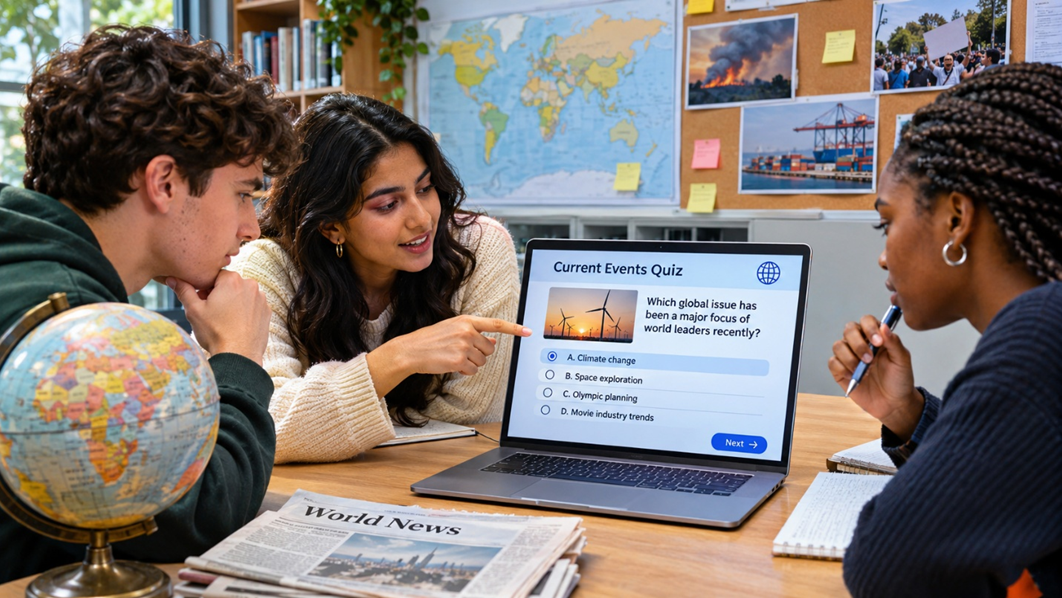
Current events quizzes are one of the simplest ways to close that gap. A short set of questions about recent headlines asks students to notice what is happening, recall what they read and think about why it matters. The format is familiar from everyday life, too: millions of people test themselves with daily trivia such as Bing homepage quiz questions and answers, which pair a single image or theme with questions that send curious readers off to learn more about a place, a person or an event.
For students, these quizzes do far more than reward the few who already follow the news. They link classroom subjects to real situations, sharpen reading and reasoning skills, build the background knowledge that makes difficult texts easier to understand, and encourage young people to see themselves as informed participants in society rather than passive spectators.
In this article, we look at how current events quizzes achieve all of that, what research on learning and news literacy suggests about them, where their limits lie, and how students, teachers and parents can make the most of them.
What Is a Current Events Quiz?
A current events quiz is a set of questions about recent news, usually covering the past day, week or month. Questions may touch on government and elections, science and health, business and technology, the environment, sports, arts and entertainment, or international affairs. Formats range from quick multiple-choice rounds to open-ended prompts that ask students to summarize or explain a story in their own words.
What separates a good current events quiz from simple trivia is purpose. Rather than asking only who did what, a well-designed quiz also nudges students to consider where an event happened, why it is significant and how it connects to things they already know. That shift from isolated facts to context is where most of the learning happens.
Many students first meet the format online. Daily quizzes built on the latest headlines, such as today’s bing news quiz questions, make it easy to check in on the news in a few minutes, see the answers instantly and return tomorrow for a fresh set. Teachers increasingly use similar quizzes as warm-ups at the start of class, as weekly review activities or as springboards for discussion.
Connecting Classroom Subjects to Real Life
“When will I ever use this?” is one of the most common questions students ask. Current events quizzes answer it every week. A single news cycle can touch nearly every subject on a school timetable, and a quiz question is often the moment a student realizes that a lesson was not just for the test.
| School subject | How the news brings it to life | Example quiz angle |
| Science | Space missions, disease outbreaks, climate research, new medical treatments | Which planet is a newly launched probe heading to? |
| Mathematics | Inflation rates, election percentages, population data, sports statistics | If prices rose 3 percent, what does a $50 item now cost? |
| Geography | Natural disasters, border disputes, trade routes, international summits | In which country did this week’s earthquake occur? |
| History and civics | Anniversaries, court rulings, new laws, elections and treaties | Which branch of government issued the decision? |
| Economics | Interest rates, job reports, company earnings, global trade | What does a central bank raise to fight inflation? |
| Language and literature | Speeches, book prizes, new words added to dictionaries | Which author won a major literary award this year? |
| Arts and culture | Film festivals, museum openings, heritage sites, music records | Which city hosted this year’s major film festival? |
These links work in both directions. School knowledge makes the news easier to understand, and the news gives school knowledge a reason to stick. A student who has just studied plate tectonics will read an earthquake report with far more understanding, and a student who answers a quiz question about that earthquake is far more likely to remember the plate tectonics lesson.
Building News Literacy and Critical Thinking
Today’s students are surrounded by information, but being surrounded by it is not the same as understanding it. In a well-known 2016 study by the Stanford History Education Group, more than eight in ten middle school students could not tell a sponsored advertisement from a real news story, and many high school and college students struggled to judge whether online sources were credible. Later research by the same team found similar weaknesses.
Current events quizzes can help build the habits that protect against misinformation, especially when they go beyond recall.
- Checking facts against reliable sources. When students look up an answer they were unsure about, they practice finding and comparing trustworthy reporting.
- Separating fact from opinion. Questions can ask whether a statement is a verifiable fact or a commentator’s view, a distinction many young readers find difficult.
- Noticing what is missing. A follow-up question such as “What else would you want to know?” teaches students that a headline rarely tells the whole story.
- Spotting misleading claims. True-or-false questions built around viral rumors show how easily half-truths spread.
- Considering multiple perspectives. Discussing why different groups react differently to the same event encourages fair-minded reasoning.
These are the same skills employers, universities and democracies rely on. A student who regularly asks “How do we know this is true?” during a five-minute quiz is rehearsing a habit that will serve them for life.
Building Background Knowledge That Improves Reading
Reading comprehension depends heavily on what a reader already knows. In a classic 1988 study, researchers Donna Recht and Lauren Leslie asked students to read a passage about a baseball game. Weaker readers who knew a lot about baseball understood and recalled the passage better than strong readers who knew little about the sport. Background knowledge, not just reading skill, made the difference.
Read More: Unlocking Every Student’s Potential: How Individualized Learning Elevates Academic Success
Cognitive scientist Daniel Willingham and education writer Natalie Wexler have popularized the same point: students who know more about the world find it easier to learn even more. Every name, place and idea a student recognizes reduces the effort needed to make sense of a new text.
Current events quizzes add to that store of knowledge a little at a time. Over a school year, a student who answers a few questions each week will have met dozens of countries, leaders, organizations, scientific ideas and economic terms. When those words appear later in a textbook, an exam passage or a university lecture, they are already familiar.
News quizzes also build vocabulary in context. Terms such as “tariff,” “ceasefire,” “referendum,” “vaccine efficacy” or “recession” are far easier to remember when attached to a real story than when memorized from a list.
Developing Global Awareness, Empathy and Civic Responsibility
A student’s daily life usually revolves around home, school and friends. Current events quizzes widen that circle. One week’s questions might involve a flood in South Asia, a peace agreement in Africa, a technology launch in North America and a cultural festival in Europe. Each question is a small window into how other people live and what they face.
That exposure matters because global awareness is now treated as a core skill. The OECD added a “global competence” assessment to its 2018 PISA tests, measuring how well 15-year-olds understand international issues and appreciate different perspectives. Regular contact with world news is one practical way to build that competence.
Read More: What to Do When Your Child Says They Hate School
News quizzes can also nurture empathy. Learning about a refugee crisis, a drought or a community rebuilding after a disaster gives students a reason to imagine other people’s experiences. Teachers can extend a quiz question into a short discussion: How might people in that country feel? What would you do in their place?
Finally, current events knowledge underpins civic life. Researchers at CIRCLE, the youth civic engagement center at Tufts University, have long found that young people who discuss current issues in school tend to show stronger civic knowledge and are more likely to participate as adults. Knowing who represents you, how laws are made and which issues affect your community is the starting point for having a voice.
Why the Quiz Format Works So Well
Students could simply read the news, so why turn it into a quiz? Because the format taps into several well-established principles of how memory works.
- Retrieval practice. Recalling information strengthens memory more than rereading it. Research by Henry Roediger and Jeffrey Karpicke showed that students who practiced recall remembered far more a week later than those who only reread the same material.
- A question creates a small gap between what you know and what you want to know. Studies by Min Jeong Kang and colleagues found that people remember answers better when they are curious about them, and news stories naturally invite curiosity.
- Weekly or daily quizzes return to the news at regular intervals, which slows forgetting far better than one long cram session.
- Seeing the correct answer immediately, especially after a confident mistake, makes the correction more memorable.
- Low pressure, high engagement. A short, ungraded quiz feels more like a game than an assignment, so students are more willing to take part and take a guess.
In other words, a quiz does not just measure whether students followed the news. It helps the news stay with them, which is what allows them to connect it to future learning.
Challenges to Keep in Mind
Current events quizzes are valuable, but they work best when used thoughtfully.
| Challenge | Why it matters | A better approach |
| Trivia without context | Memorizing names and dates alone builds little understanding | Add a “why does this matter?” question or a short follow-up discussion |
| Distressing news | Wars, disasters and crimes can upset younger students | Choose age-appropriate stories, balance hard news with positive stories, and leave room to talk |
| Political bias | Loaded wording can make students feel judged or pushed toward a view | Write neutral questions, focus on verifiable facts and present multiple perspectives |
| Unequal access to news | Students who lack devices or news at home start behind | Share a short reading or summary before the quiz so everyone has a fair chance |
| Fast-changing stories | Early reports are sometimes corrected later | Use reputable sources, note when facts are still developing and revisit stories |
| Score anxiety | Grading news knowledge can feel unfair | Keep quizzes low stakes and reward participation and improvement |
None of these challenges is a reason to avoid current events. They are reasons to design quizzes with care, so they inform and empower students rather than overwhelm them.
How to Get the Most From Current Events Quizzes
For students
- Make it a habit. Take a short news quiz at the same time each day or week, such as during breakfast or on the commute.
- Guess first, then learn. Commit to an answer before checking. Even wrong guesses make the correct answer more memorable.
- Follow the questions you miss. Read one reliable article about each story you did not know. That is where the deepest learning happens.
- Connect it to class. Ask yourself which subject each story relates to and how.
- Talk about it. Share an interesting question with a friend or family member. Explaining a story helps you understand it.
For teachers
- Use a five-question quiz as a weekly warm-up, then pick one story for a deeper discussion.
- Mix local, national and international stories, plus a few hopeful or surprising ones.
- Include at least one question that asks students to explain, predict or evaluate, not just recall.
- Invite students to write quiz questions about stories they found, which builds research and summarizing skills.
- Link questions to the current unit whenever possible, so the news reinforces the curriculum.
For parents
- Take a daily quiz together and turn it into a friendly family challenge.
- Ask open questions such as “What surprised you?” or “Why do you think that happened?”
- Help children choose trustworthy news sources and talk about how to tell when a story might be unreliable.
- Be ready to talk about difficult stories calmly, and limit exposure to graphic content for younger children.
Frequently Asked Questions
What age is appropriate for current events quizzes?
Children as young as eight or nine can enjoy simple quizzes built on kid-friendly news. Older students can handle more complex topics, such as economics and international relations. The key is matching the stories and wording to the learner’s age.
How often should students take current events quizzes?
A short quiz once a week works well in most classrooms. Students who enjoy the format can benefit from a few minutes of daily practice, which also builds the habit of following the news.
Do current events quizzes improve academic performance?
They support skills linked to academic success, including reading comprehension, vocabulary, background knowledge and critical thinking. They work best as a complement to regular lessons, not a replacement.
How can teachers keep current events quizzes politically neutral?
Focus questions on verifiable facts, use neutral language, draw on reputable sources across the spectrum and present more than one perspective when discussing contested issues.
Are online news quizzes reliable?
Quality varies. Look for quizzes that are updated regularly, draw on established news outlets and provide answers or explanations so learners can check their understanding.
Final Thoughts
School gives students the tools to understand the world. Current events quizzes give them regular practice using those tools on the world as it is right now. In a few minutes a week, students connect lessons to real situations, learn to question what they read, build knowledge that makes future reading easier, and develop the awareness and empathy that responsible citizenship requires.
The best part is how simple it is to start. One quiz, one question you could not answer, and one article to find out why is enough to turn a passing headline into real understanding. Over time, those small moments add up to something every education aims for: young people who are curious about the world beyond the classroom and ready to take their place in it.