
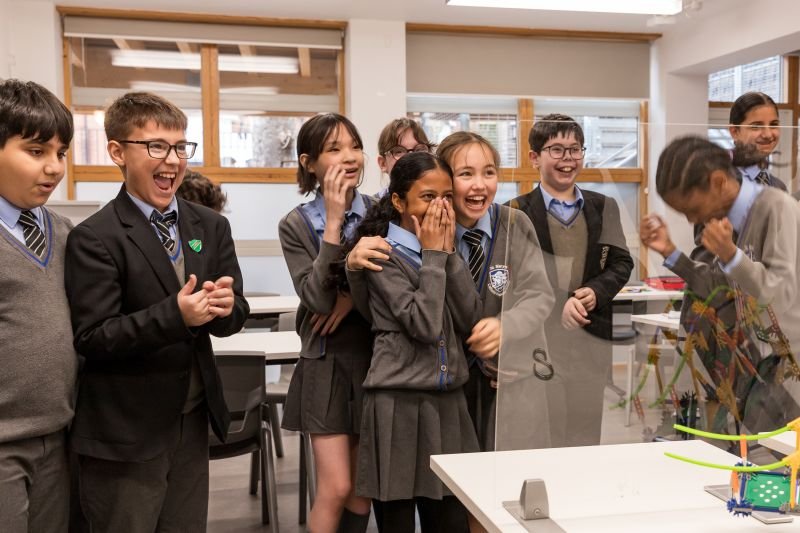
Ask a room of nine-year-olds who wants to be an engineer, and the hands shoot up regardless of gender. Something shifts in the years that follow. By the time students pick their A-levels, girls are still under-represented in physics, computing and engineering, not because of ability, but because of a hundred small signals that tell them these subjects belong to someone else. The good news is that those signals can be challenged. Here are six ways schools and families can help girls stay in STEM and thrive there.
1. Start the conversation early
Interest in science, technology, engineering and maths forms long before secondary school. Primary-age children who build, tinker and ask “how does that work?” are already doing STEM. Protecting that curiosity, rather than quietly steering it towards “safer” subjects, matters enormously.
Read More: Why Sport Belongs at the Heart of a Girls’ Education
Takeaway: Curiosity is the foundation. Guard it before stereotypes have a chance to settle in.
2. Make role models visible
Girls are more likely to pursue a subject when they can picture themselves doing it. That means putting female scientists, coders and mathematicians in front of them, from historical figures to the researcher who visited last term. Representation is not a nice extra. It is evidence that the door is open.
Takeaway: You cannot be what you cannot see, so make sure she sees it often.
3. Reframe failure as part of the process
Research consistently shows that girls can be more sensitive to the fear of getting things wrong in technical subjects. Yet trial and error is how science actually works. Classrooms that treat a failed experiment as useful data, not a personal shortcoming, keep more girls engaged and willing to take intellectual risks.
Takeaway: A wrong answer is a step forward, not a verdict on ability.
4. Build confidence through hands-on work
Theory alone rarely sparks commitment. Practical work (coding a game, wiring a circuit, designing a bridge that genuinely has to hold weight) turns abstract ideas into achievements a student can point to. Schools that prioritise this kind of active learning tend to see confidence rise across the board. Settings such as an independent girls’ school with a strong focus on academic breadth often weave problem-solving into everyday lessons rather than saving it for special occasions.
Takeaway: Confidence grows from doing, not just listening.
5. Challenge the language we use
Casual remarks shape ambition more than we realise. Describing maths as “hard” or praising a girl for being “neat and organised” while praising a boy for being “clever” sends a message. Deliberate, even-handed language helps every student feel equally entitled to the difficult, exciting parts of a subject.
Takeaway: Watch the words. They do quiet, lasting work.
6. Connect STEM to the wider world
Girls are often drawn to subjects they can link to purpose: tackling climate change, improving healthcare, designing cities that work for everyone. Framing STEM around the problems it solves, rather than the equations it involves, broadens its appeal and reminds students why the work matters.
Takeaway: Show the point of it, and the motivation follows.
A full stop, not a question mark
The title of this piece ends with “full stop” for a reason. Whether girls belong in STEM should not be up for debate. The real task is building environments where they can take these subjects as far as their talent allows, without doubting that the invitation was meant for them. Families looking for schools that take this seriously can start by reading more at https://butehouse.co.uk.
—
*This article was written on behalf of Bute House School, an independent preparatory school for girls in Hammersmith, West London. Known for its warm, ambitious approach to learning, Bute House encourages pupils to explore science, maths and technology with curiosity and confidence, preparing them for leading senior schools and beyond.*
Read More: What a School Open Day Actually Tells You (If You Know What to Look For)